Actors Kathryn Wikstrom and Carlen Kernish

Playwright Jason Sebacher

Another show closed


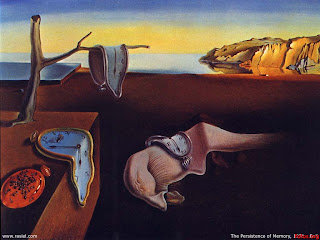
 My studies of Dalí and his art first inspired me to write Perchance to Dream. I am so intrigued by the notion of the subconscious mind and its role in our life. Dalí’s art was called “Surreal” (as if anyone didn’t already know), meaning it is an unedited rendering of the images seen in the mind’s eye. There were many Surrealists in Dalí’s day. However, Dalí distinguished himself by creating art on a greater and deeper level; he himself was the piece of art. Dalí lived his life around fulfilling his desires, the desires we all have, deep from the subconscious. He had the modest goals of achieving nothing more than worldwide fame, unending sex, and fabulous wealth. In his youth, Dalí as a personality was as infamous as his art, for, really, they had deliberately become one and the same. The ingenious thing about Dalí—the reason I call him the greatest artist ever to live—was because he was wholly (and I mean wholly) devoted to his art, so much so that he had crafted a complex, swirling universe with its own physical laws and logic, a universe he expressed onto the canvas. To put it simply, the art pieces Dalí created did not comprise their own world, but instead were reflections of the actual—though, necessarily, imaginary—worlds he lived. There is a difference. Dalí’s paintings do not exist as some other thing, something separate from reality. Instead, they depict a reality quite unfamiliar to us, though it is a reality that is importantly all the more real precisely because we cannot see it: it exists only in the subconscious mind, which is indeed more real than the series of patterns that our conscious mind fabricates and we take for granted as existing in front of us. You see, Dalí tapped into something that to my knowledge has yet to be tapped in to, being the true nature of things. True art, he would say, is that which is uniquely human, that does not imitate nature but enacts nature. And getting in touch with our subconscious mind is the path to true self-knowledge and self-actualization, and the only way to become mentally-healthy. Dalí was in touch with his subconscious—so I say—but his life would certainly dissuade anyone to argue that he was healthy.